Hard Times & Harsh Walls: Victorian Workhouses in Sheffield
During the Industrial Revolution Sheffield expanded rapidly. Steel and cutlery made the city wealthy, but for many ordinary people, Victorian Sheffield was defined by grinding poverty and limited social support. One of the starkest responses to poverty in the 19th century was the workhouse system.
HISTORY
Laura Newheiser
1/31/20262 min read
What Were Workhouses?
Workhouses were institutions where those who couldn’t support themselves usually the elderly, disabled, sick, children, and unemployed there they were offered food and shelter in exchange for work. After the Poor Law Amendment Act of 1834, Poor Law Unions were formed across England and workhouses became the central mechanism for poor relief. The goal was not only to provide basic care but also to deter people from seeking relief if they could avoid it.
In Sheffield, this meant building larger, more formal workhouses to replace earlier, smaller parish support systems.
Sheffield’s Workhouses: From Early History to Victorian Era
Sheffield’s first recorded workhouse was financed in 1628 near West Bar (now Paradise Street). It was modest in scale, housing perhaps fewer than 200 people, and overseen by a “Master of the children.”
Over the 18th century, this workhouse grew to accommodate more residents, with men working outside when possible, and women and children performing textile tasks inside.
The Victorian era brought both industrial expansion and greater urban poverty. Following the 1834 reforms, two major workhouses were established for Sheffield:
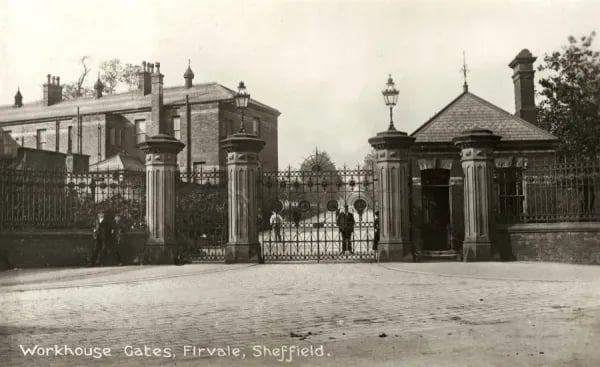
Sheffield Union Workhouse – originally based on Kelham Island, eventually relocated to Fir Vale. This institution would later evolve into what became the Northern General Hospital.
Ecclesall Bierlow Union Workhouse – serving the southern parts of the city, later located in Nether Edge and eventually known as Nether Edge Hospital.
These workhouses weren’t just shelters; they were intended to be bleak and uncompromising, discouraging anyone from seeking relief unless absolutely necessary. Family members were often separated upon entry, and inmates were issued coarse uniforms rather than their own clothes.
Life Inside: Daily Routines and Hard Work
Life in a workhouse was tough. Conditions were deliberately stark:
Work tasks were menial and physically demanding: breaking rocks, oakum picking (tearing apart old rope), or scrubbing floors.
Separation of families was common — husbands, wives, and children could all be housed apart.
Food and shelter were provided, but there was no money — only the bare minimum to survive.
Workhouses held a stigma. The threat of ending up inside one was so feared that it acted as a form of social control over the poor.
Beyond the Workhouse: Legacy and Transformation
By the early 20th century, the workhouse system was increasingly seen as outdated. Its role started shifting toward healthcare as Britain’s social welfare system evolved.
The Sheffield Union Workhouse site at Fir Vale was absorbed into the local health services and eventually became part of the Northern General Hospital.
The Ecclesall Bierlow workhouse in Nether Edge later became a hospital known as Nether Edge Hospital.
The formal poor law system was abolished in 1929, and workhouses ceased to function in their original form. Yet, their buildings and legacy continued to shape healthcare and welfare in Sheffield for decades.
Why It Matters Today
Victorian workhouses like those in Sheffield offer powerful insights into:
How society dealt with poverty before modern welfare systems
The lived experience of the urban poor
The origins of contemporary social care and public health institutions
Walking the streets of Sheffield today — where factories, hospitals, and Victorian housing sit side by side — you can trace the deep roots of industrial England’s social history. From humble parish systems in the 1600s to the sprawling institutional complexes of the Victorian age, workhouses tell a story of struggle, survival, and eventual reform.