What My DNA Test Revealed About My Ancestry (Full Breakdown of My Ancestry Results)
If you’ve ever taken an ancestry DNA test, you’ll know how exciting it is to see your genetic breakdown for the first time. My results revealed a surprising mix of English, Irish, Welsh, Germanic, Dutch, and Scandinavian ancestry—showing just how interconnected family histories can be. In this post, I’ll break down my DNA ancestry results, explain what each region means, and share what I discovered about my family heritage.
GENEALOGY RESEARCH
Laura Newheiser
5/5/20262 min read
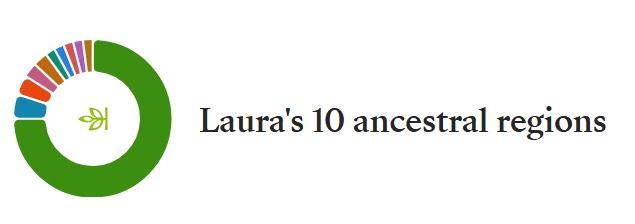
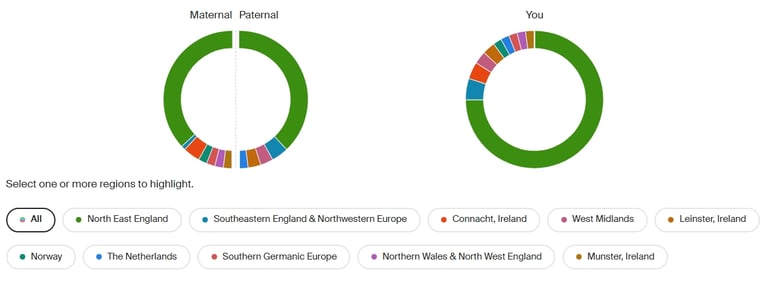
My DNA Ancestry Results Overview
Here is a quick summary of my ethnicity estimate:
North East England – 75%
Southeastern England & Northwestern Europe – 5%
West Midlands (England) – 3%
Connacht (Ireland) – 4%
Leinster (Ireland) – 3%
Munster (Ireland) – 2%
Northern Wales & North West England – 2%
Southern Germanic Europe – 2%
The Netherlands – 2%
Norway – 2%
These results show that my ancestry is mostly rooted in the United Kingdom and Ireland, with additional influences from mainland Europe and Scandinavia.
Strong English Heritage: North East England Roots
The largest portion of my DNA—75% from North East England—suggests that most of my family heritage is strongly tied to this region.
North East England has a rich cultural and industrial history, known for mining towns, shipbuilding, and strong working-class communities. This makes me wonder what life was like for my ancestors who lived there generations ago. This region forms the core of my ancestry DNA results, giving me a strong sense of English identity and historical connection.
Irish and Celtic Ancestry in My DNA
My results also show clear Celtic and Gaelic ancestry, spread across different regions of Ireland and parts of Wales:
Connacht (Ireland) – 4%
Leinster (Ireland) – 3%
Munster (Ireland) – 2%
Northern Wales & North West England – 2%
This suggests that at some point in my family history, my ancestors may have lived across Ireland and Wales before moving or mixing into England.
This Celtic heritage adds depth to my ancestry story, connecting me to ancient cultural traditions, languages, and regional history across the British Isles.
European DNA: Germany and the Netherlands
A smaller but interesting part of my DNA comes from continental Europe:
Southern Germanic Europe – 2%
The Netherlands – 2%
These results could reflect historical migration patterns, trade routes, or movement between the UK and mainland Europe over centuries. Even small percentages in DNA ancestry tests can reveal meaningful historical connections.
Scandinavian Ancestry: A Norwegian Link
One of the most surprising findings in my DNA results was:
Norway – 2%
This may suggest distant Viking-era ancestry or later migration from Scandinavia into the British Isles. Many people in the UK and Ireland share small amounts of Scandinavian DNA due to historical Viking influence. It adds an unexpected but fascinating layer to my family ancestry history.
What My DNA Results Mean for My Family History
Looking at the full breakdown, my ancestry tells a clear story:
A strong base in North East England
Deep Irish and Celtic roots
Smaller connections across Europe and Scandinavia
What stands out most is how interconnected everything is. My DNA shows that family history is rarely limited to one place—it’s shaped by centuries of movement, migration, and cultural blending.
Final Thoughts: What I Learned From My Ancestry DNA Test
Taking an ancestry DNA test gave me more than just percentages—it gave me a deeper understanding of my identity and heritage. It made me realize that my family history spans multiple regions and cultures, and that every small percentage has a story behind it.
If you’re considering taking a DNA test, be prepared—you might discover that your ancestry is far more diverse and interesting than you expected.